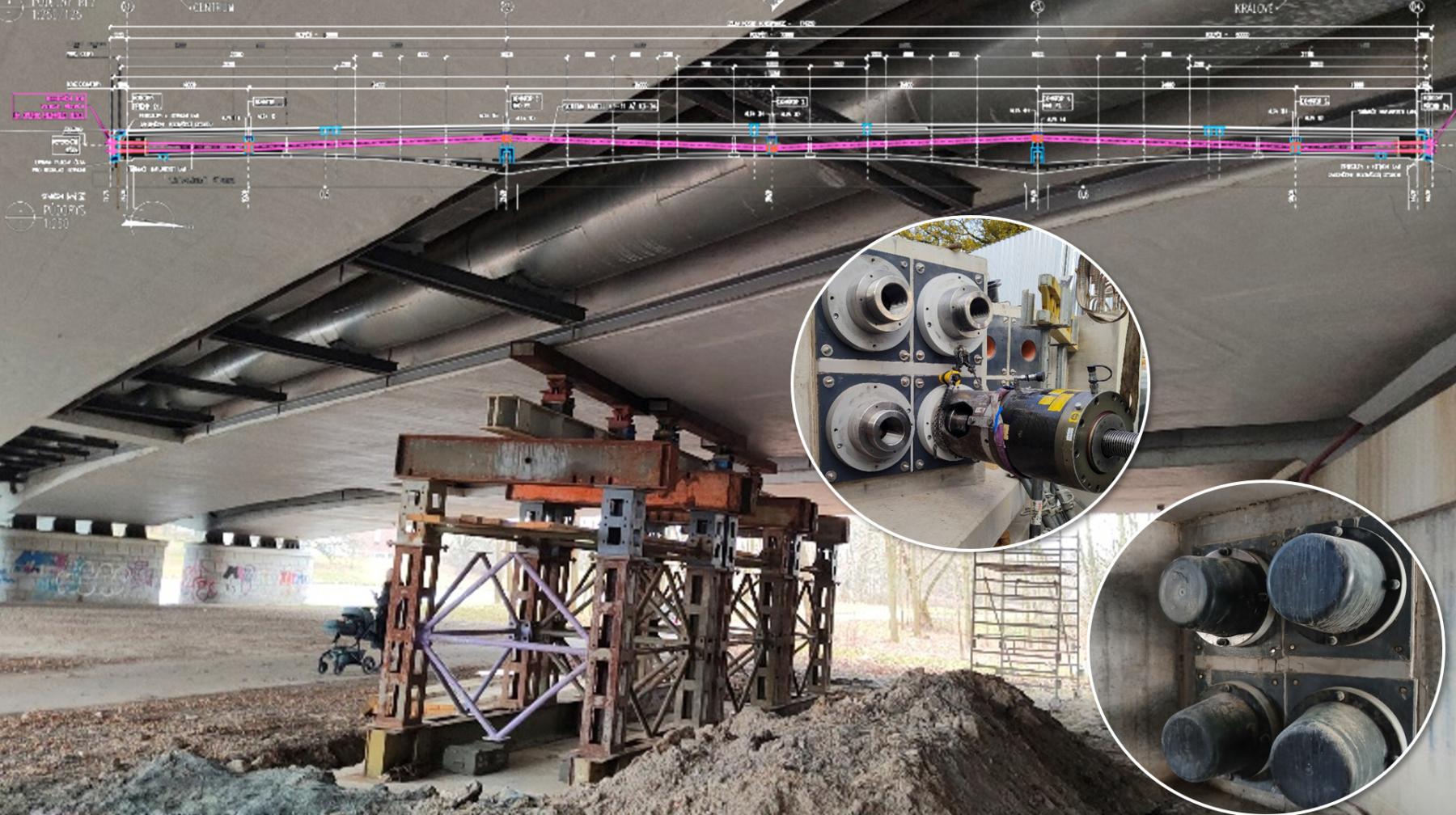
PROJECT OF THE MONTH 05/2026 | Structural dynamic monitoring for the gradual bridge retrofitting with BRIMOS® Structural Health Monitoring.
In the scope of gradual retrofitting of the existing bridge Most Pavla Wonky in Pardubice, Czech Republic a complex infrastructure project is realized without interrupting traffic. The client is the construction company Chládek a Tintěra, Pardubice a.s.. Target is the sustainable restoration of the existing prestressed concrete bridge by means of an exchange of the external prestressing in the box girders as alternative to an early replacement construction.
VCE is responsible for the design of a permanent, structural dynamic monitoring system as well as the continuous evaluation of measurement data and the assessment of the load-bearing capacity during the construction levels. The technology applied is BRIMOS® Structural Health Monitoring, which enables continuous monitoring of the construction levels during the retrofitting measures.
The works are supervised by the VCE Competence Center Life Cycle Engineering & Asset Management. In cooperation with MDS projekt s.r.o. and STATOTEST s.r.o. an integrated monitoring and evaluation concept is established, which represents the load-bearing behaviour during the various construction levels, any load redistributions, and particularly the efficiency of bridge retrofitting in real time.
“Monitoring allows us to quantitatively assess the structural reaction in every construction phase and to ensure structural safety during bridge retrofitting. Thus, we have created an essential decision support during the complex reconstruction process under full operation”, declared Robert Veit-Egerer, project manager of the CC Life Cycle Engineering & Asset Management at VCE.
Technically the focus is on the combination of the digital building model, the continuous sensor system as well as the evaluation and engineering interpretation of measurement data in the context with the construction phases. Consequently, an essential decision basis is made available in the building process during the gradual exchange of external prestressing.
The project is an example for the use of digital engineering in infrastructure projects, where data-based decision processes are directly integrated into construction. The connection of monitoring, digital structural models and the expert assessment enables a reliable supervision of construction levels.
A considerable added value of the project is the claim of sustainable use of the existing infrastructure: By means of retrofitting of existing structures the use of resources is considerably reduced, and early replacement constructions are avoided. Thus, the project contributes to the strategic objective to increasingly plan infrastructure measures under the aspect of life-cycle consideration and resource efficiency.